

How Strong Corporate Partnerships Are Built
Strong corporate partnerships don’t begin with a sponsorship package or a long list of company names.
They begin by understanding what your nonprofit already brings to the table, translating that value into business relevance, focusing on the right companies, and leveraging existing relationships where they can help open the door to better conversations and stronger alignment.
From there, the work becomes about designing opportunities that help both organizations make progress.

The Shared Value Bridge
Different goals. Shared opportunity.
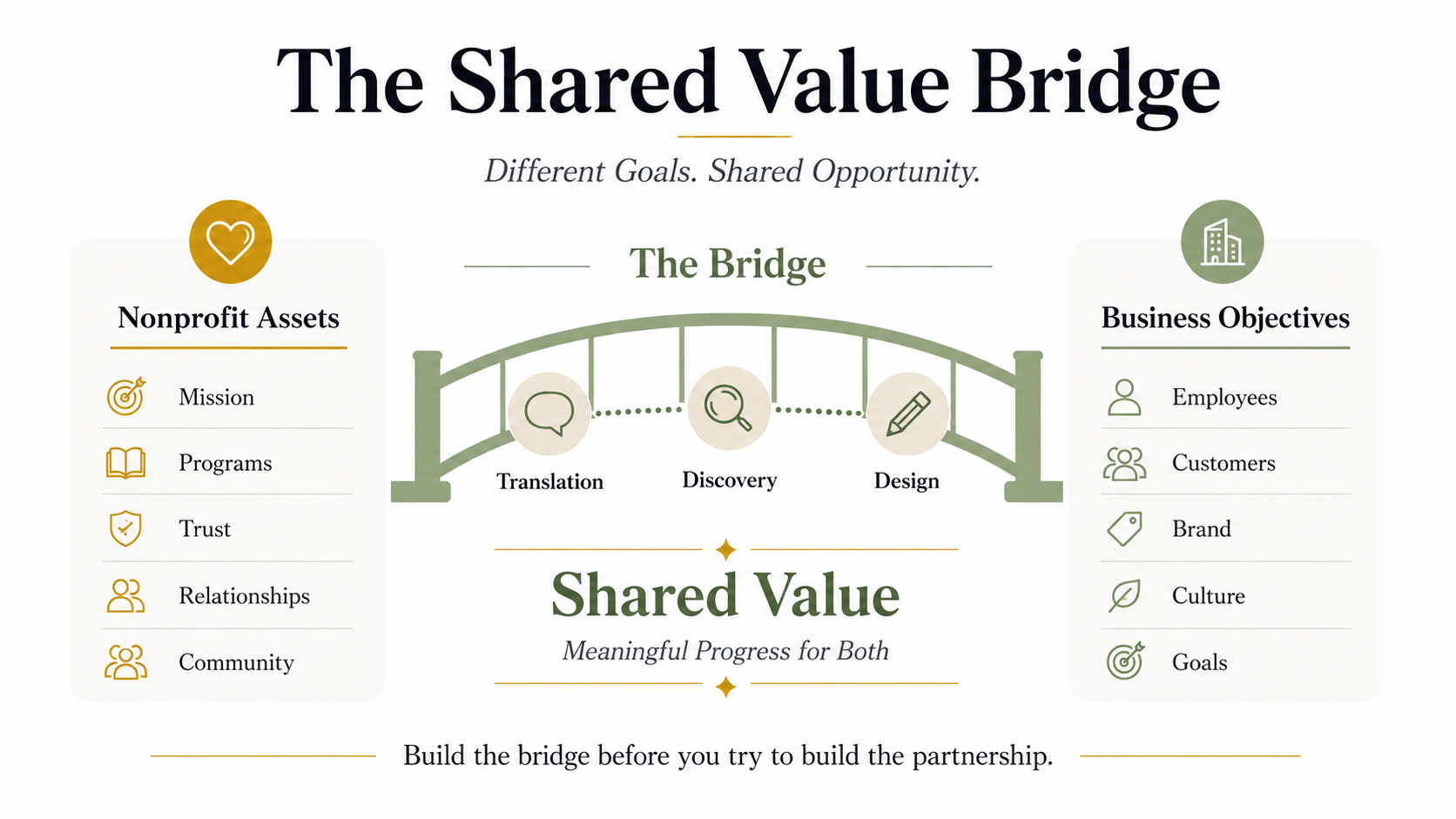
Nonprofits and businesses often enter partnership conversations from very different starting points.
Your nonprofit may be thinking about mission, programs, community needs, relationships, trust, and the people you serve. A business may be thinking about employees, customers, brand, culture, growth, or other organizational priorities.
The strongest partnerships are built when those two sides are connected intentionally.
That’s the role of the Shared Value Bridge.
On one side are the assets your nonprofit already brings to the table. On the other are the objectives a business is trying to advance. In between are the conversations and decisions that help translate one into the language of the other, uncover where genuine alignment exists, and shape an opportunity that creates meaningful progress for both sides.
The goal isn’t to make your organization sound more corporate. It’s to make the relevance of your mission, programs, relationships, expertise, and community value easier for the right companies to understand.
Shared value happens when both sides can clearly see why the partnership matters.
Core Principles
The strongest corporate partnerships are built differently.
They don’t begin with a generic sponsorship menu or a race to contact as many companies as possible. They begin with a clearer understanding of value, relevance, relationships, and what both sides are actually trying to accomplish.
Start with value, not need
Your mission matters, but companies also need to understand what your organization brings that is relevant to their goals, employees, customers, brand, or community priorities.
Translate before you reach out
Don’t make businesses do the work of figuring out why your programs, audiences, expertise, relationships, or stories matter to them.
Focus on alignment, not volume
A smaller group of well-matched companies is more valuable than a long list of names with little connection to your work.
Use relationships intelligently
Existing board, staff, volunteer, donor, and community relationships can create warmer and more credible paths into the right companies.
Let discovery shape the opportunity
The first conversation should help both sides learn. Strong partnerships are designed around what you uncover, not forced into a predetermined package.
Build for shared progress
The best partnerships create something meaningful for the nonprofit and the business, with room to deepen over time.
What This Looks Like In Practice
A methodology only matters if it helps you make better decisions.
The work becomes practical through a series of tools, research outputs, and conversations that help your organization focus, learn, and move the right opportunities forward.
Depending on the engagement, that may include:
Partnership Foundation
A clear articulation of your organization’s assets, positioning, partnership priorities, and business-relevant value.
Partner Archetypes
Profiles of the types of companies most likely to align with your mission, programs, audiences, and opportunities.
Prospect Opportunity Portfolio
A prioritized group of companies worth exploring based on fit, relevance, and potential rather than volume.
Prospect Profiles
Practical intelligence on priority companies, including relevant activity, decision-makers, relationships, and areas worth exploring.
Relationship Mapping
A clearer view of board, staff, volunteer, donor, and community connections that may create stronger paths into the right companies.
Outreach Wave Plan
A focused sequence for approaching prospects, including messaging, timing, follow-up, and where warmer relationship paths may exist.
Partnership Design and Growth Planning
Ideas and next steps shaped around what both sides learn through discovery, with an eye toward opportunities that can deepen over time.
These aren’t documents created for their own sake. They’re working tools designed to help your team make better decisions, have stronger conversations, and build a process you can continue using.

What Changes When You Work This Way
The goal isn’t simply to become better at corporate outreach.
It’s to become more focused about where you spend time, more confident in how you communicate value, and better prepared to recognize which opportunities are actually worth pursuing.
Working this way can help your organization:
Spend less time chasing companies with little real fit
Approach conversations with stronger positioning and more relevant context
Make better use of existing relationships and warm paths
Learn more before designing the partnership
Move from one-off sponsorship thinking toward relationships that have room to grow
You’re not trying to convince every company. You’re trying to find the right ones, understand what matters to them, and build something worth continuing.
Ready to Build a Stronger Corporate Partnership Approach?
You don’t need to change your mission. You need a clearer way to understand your value, identify the right opportunities, and move the right relationships forward.
If you’re ready to put this approach into practice, we can start with where your organization is today and what level of support makes sense.